No-KYC crypto casinos advertise cryptocurrency payments without the lengthy identity checks associated with conventional financial services. Some international gambling platforms combine simplified registration with Bitcoin withdrawals, while others promise instant payments to external wallets. These features can appear convenient, but they do not necessarily guarantee anonymous gambling or unrestricted access to winnings.
This guide explains how no-verification casino claims work, why withdrawal thresholds matter and what can interrupt a supposedly instant Bitcoin payment. It focuses on privacy, payment transparency and the distinction between registering without documents and withdrawing without verification.
Australian readers also need to understand the legal position. Australia's Interactive Gambling Act prohibits operators from providing online casino services to people in Australia. Cryptocurrency and offshore licensing do not override that restriction.
What Is a No-KYC Crypto Casino?
A no-KYC crypto casino is generally described as a gambling platform that permits certain account activities without completing conventional Know Your Customer identity checks.
The phrase can refer to several different arrangements. Some websites request only basic registration information. Others accept cryptocurrency deposits before requiring identification documents. A smaller group advertises automatic withdrawals for transactions meeting particular conditions.
These arrangements are not interchangeable. A customer may register without uploading identification but encounter verification when requesting a withdrawal.
When reading no-KYC casino advertising, it helps to distinguish initial account access, deposit acceptance, withdrawal approval and the conditions that may trigger additional identity checks.
No-KYC Registration vs No-Verification Withdrawals
One of the most important distinctions concerns when identity verification occurs.
Registration may require only an email address, password and basic account information. This does not establish that the operator will allow all future cryptocurrency withdrawals without documentation.
Withdrawal verification can involve confirming identity, age, address or payment ownership. An operator may introduce additional checks after a particular transaction or account activity.
The following comparison explains the differences.
| Feature | What It Means | Important Limitation |
|---|---|---|
| Simplified Registration | Limited information collected initially | Further checks may follow |
| No-KYC Deposit | Funds accepted before full identification | Does not guarantee withdrawal eligibility |
| Instant Crypto Withdrawal | Fast approval or payment initiation | Network confirmation can take longer |
| Verification Threshold | Conditions that may trigger additional checks | Thresholds may change or remain undisclosed |
| Anonymous Wallet | Wallet may not display a legal name | Blockchain activity remains traceable |
A claim combining all five features should not be accepted without clear contractual evidence. Even automated withdrawals may be reviewed when compliance or security concerns arise.
How Instant Crypto Casino Withdrawals Work
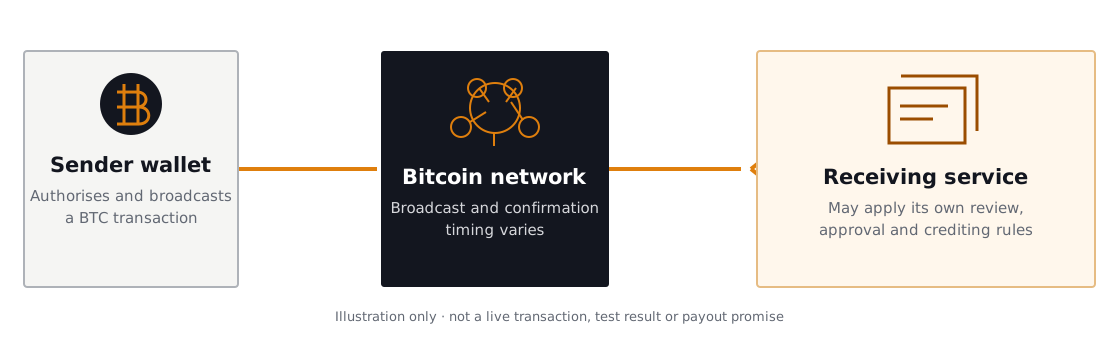
An instant withdrawal crypto casino relies on several systems operating together. The account balance must be eligible, the operator must authorise payment and the cryptocurrency network must process the transfer.
Step 1: Requesting a Withdrawal
A withdrawal begins when an eligible account requests funds through a supported payment method.
The operator may review minimum withdrawal amounts, bonus conditions, account restrictions and the selected wallet address.
At this stage, the customer has submitted an instruction rather than necessarily initiated an actual blockchain transaction.
Step 2: Payment Approval
Some operators advertise automated approval for eligible cryptocurrency payments. Others reserve the right to conduct manual checks.
These checks may concern account ownership, identity, promotional activity or transaction security.
Approval time is often more important than the advertised speed of the underlying blockchain.
Step 3: Blockchain Settlement
Once approved, the payment provider broadcasts the cryptocurrency transaction.
Bitcoin requires network confirmation, while assets such as Ethereum, Litecoin and Tether use different settlement arrangements.
The receiving wallet may detect a transaction before considering the funds fully available.
Consequently, instant approval does not automatically mean instant wallet receipt.
Why No-KYC Bitcoin Withdrawals Can Be Delayed
No-verification advertising does not eliminate technical or administrative delays.
A casino may review an unusual withdrawal, request additional information or temporarily restrict transactions while investigating account activity.
Outstanding bonus wagering and maximum cashout limits may also affect whether a balance is eligible for withdrawal.
After approval, network congestion, transaction fees and wallet confirmation requirements can extend settlement.
For Bitcoin, new blocks are produced approximately every ten minutes on average, but individual confirmation times vary.
A promotional claim promising a ten-minute Bitcoin payout therefore cannot establish a universal maximum for every transaction.
What Are No-KYC Withdrawal Thresholds?
A withdrawal threshold is an amount or condition that may influence how a financial service reviews transactions.
Some international gambling platforms describe different verification arrangements for smaller and larger payments.
However, no universal monetary threshold guarantees withdrawal without KYC across cryptocurrency casinos.
Operators may request identification regardless of transaction size, particularly where their compliance procedures require additional checks.
Several small withdrawals may also be reviewed together when assessing account activity. Dividing transactions does not guarantee exemption from verification and may itself prompt further scrutiny.
Any advertised no-KYC limit is best treated as an operator-specific claim that requires confirmation in current terms, not as a generally applicable rule.
Privacy Benefits and Their Limitations
Cryptocurrency payments can provide a different information-sharing arrangement from conventional bank transfers.
A blockchain transaction typically uses wallet addresses rather than directly displaying an account holder's name.
This can reduce the personal information included in the public transaction record, but it does not make the transaction inherently anonymous.
Bitcoin transactions are recorded on a public blockchain. Addresses, amounts and transaction histories can be analysed and sometimes connected with real-world identities.
Exchanges, payment providers and gambling operators may also maintain account records linking transactions with identifiable customers.
Accordingly, wallet-based payments should be described as potentially pseudonymous rather than guaranteeing complete privacy.
No-KYC Casinos vs Licensed Gambling Services
Identity verification and licensing are separate questions, but they are closely connected when evaluating gambling services.
Australia's anti-money-laundering regulator, AUSTRAC, explains that covered online gambling providers have been required to complete applicable customer identification procedures before creating online gambling accounts or providing designated services since 29 September 2024.
These obligations are relevant to Australian-regulated providers. They should not be mistaken for identical rules applying to every offshore operator.
International casinos may follow different licensing frameworks, but an overseas licence does not establish permission to offer prohibited online casino services in Australia.
A website claiming both Australian authorisation and unrestricted no-verification access warrants careful examination of those claims.
Bitcoin vs USDT for Private Cryptocurrency Payments
Bitcoin and Tether have different technical characteristics.
Bitcoin operates on a public blockchain. Its transactions can be inspected, and confirmation timing depends on network conditions.
USDT is available on several blockchain networks, each with different fees, confirmation processes and wallet compatibility requirements.
Neither asset guarantees anonymous casino transactions. Issuers, exchanges or payment intermediaries may maintain additional transaction records.
The choice of cryptocurrency also does not determine whether a casino requests identity documents.
Even where a USDT transfer settles quickly, the operator's approval process may require substantially more time.
Minimum Withdrawals and Transaction Fees
Minimum cashouts can affect the practical value of cryptocurrency payments.
An operator may advertise a general minimum withdrawal in Australian dollars while applying a separate threshold to Bitcoin or USDT transactions.
Network fees can also reduce the amount ultimately received in a wallet.
Bitcoin fees vary with network demand and transaction size. USDT transfer costs depend on the supported blockchain and payment infrastructure.
Currency conversion introduces another consideration when gambling balances are denominated in AUD but withdrawals are settled in cryptocurrency.
For meaningful comparison, look at the minimum eligible payment, applicable charges and final amount expected after conversion.
Can No-KYC Casinos Offer Truly Instant Payouts?
Automated approval and rapid blockchain settlement can sometimes produce short payment times.
However, a complete instant-withdrawal guarantee would need to cover account eligibility, approval, transaction broadcasting and receiving-wallet confirmation.
Most promotional statements do not define every stage.
Even a system designed for automatic withdrawals may encounter technical interruptions, unusually large payments or transactions requiring investigation.
It is therefore important to distinguish the fastest advertised example from a documented maximum processing period.
A clear multi-hour payment policy can provide more useful information than an unsupported claim of universal immediate withdrawals.
Security Risks of No-Verification Gambling Platforms
Reduced identity checks can create operational risks alongside potential privacy advantages.
For example, weak account recovery procedures may make it difficult to establish ownership after credentials are compromised.
Cryptocurrency transfers are generally irreversible, so an incorrect receiving address can cause permanent loss.
Unclear operating-company details, missing licensing information and restrictive withdrawal terms may also complicate payment disputes.
Customers should not assume that an operator offers strong consumer protection solely because its payment system uses established blockchain technology.
Payment infrastructure and gambling-operator reliability must be evaluated independently.
How to Assess No-KYC Casino Claims
A sensible approach begins with understanding the exact service being advertised.
First, distinguish registration without immediate document uploads from an explicit commitment concerning withdrawal verification.
Second, examine the operator's published financial conditions, including minimum withdrawals, transaction limits and approval periods.
Third, establish whether the operating company and claimed gambling licence can be independently verified.
Fourth, check whether the available information explains circumstances that may trigger additional account reviews.
Finally, consider whether the operator can lawfully provide the service in the relevant jurisdiction.
No-verification branding should not substitute for clear contractual terms, transparent ownership or effective complaint procedures.
Australian Laws Affecting Crypto Casinos in 2026
The Australian Communications and Media Authority explains that operators cannot legally offer online casino services to people in Australia.
The prohibition includes online pokies, blackjack, roulette and comparable casino products.
Australia separately regulates authorised online wagering. Since 11 June 2024, regulated online wagering operators have also been prohibited from accepting digital currency for betting payments.
Consumers can consult ACMA's register of licensed interactive wagering providers when checking whether a wagering service has Australian authorisation.
An offshore gambling licence, cryptocurrency wallet or alternative domain does not override domestic restrictions.
These requirements remain important regardless of an operator's advertised withdrawal speed or registration process.
Frequently Asked Questions
What Does No-KYC Mean at a Crypto Casino?
It usually refers to reduced identity-check requirements for certain account activities. The exact meaning varies, and additional verification may still be required before withdrawals.
Can Bitcoin Casino Withdrawals Be Instant?
Some operators advertise rapid approval, but blockchain confirmations and account reviews can extend the time before funds become available.
Is There a Universal No-KYC Withdrawal Limit?
No. Thresholds depend on the operator, applicable rules and transaction circumstances. No specific payment amount universally guarantees exemption from verification.
Are Cryptocurrency Casino Payments Anonymous?
Not necessarily. Blockchain transactions are traceable, and operators or payment services may link wallet activity with customer information.
Does USDT Eliminate Identity Checks?
No. A different cryptocurrency network does not remove account verification requirements or operator compliance procedures.
Can Australian Gambling Operators Accept Cryptocurrency?
Australian-regulated online wagering operators are prohibited from accepting digital currency for betting payments. Offering online casino services to people in Australia is separately prohibited.
Does an Offshore Licence Authorise a No-KYC Casino in Australia?
No. Overseas gambling authorisation does not override Australian restrictions on prohibited interactive gambling services.
Final Assessment: No-KYC Claims and Instant Crypto Withdrawals
No-KYC crypto casino marketing brings together three distinct ideas: simplified registration, privacy-oriented payments and rapid cryptocurrency withdrawals.
These features should not be treated as a single guarantee. An operator may accept Bitcoin deposits without immediate document uploads but require verification before approving a withdrawal.
Likewise, a fast blockchain does not eliminate payment review periods, transaction limits or wallet confirmation requirements.
The most meaningful factors are transparent verification policies, clearly defined withdrawal processing, documented fees and independently checkable operating information.
For Australian readers, the legal position remains fundamental. Instant withdrawals and cryptocurrency wallets do not create permission to provide prohibited online casino services. Understanding those limitations is essential to evaluating payment claims accurately.