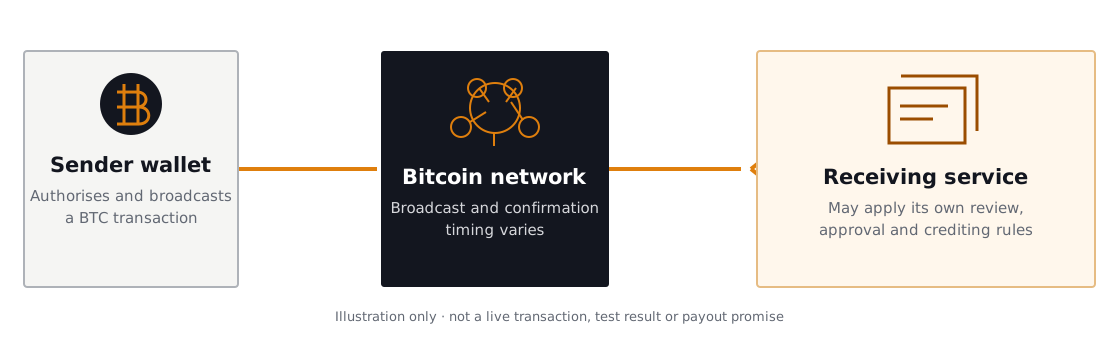
A Bitcoin withdrawal is often described as a single event, but it passes through four separate stages: approval by the sender, broadcast to the network, confirmation in a block and receipt in the recipient's wallet. Each stage is controlled by a different party, can be delayed for different reasons and is checked in a different place. Treating them separately makes payout claims easier to read.
| Stage | Controlled by | Where to check |
|---|---|---|
| 1. Approval | The merchant or operator | Account history or support |
| 2. Broadcast | The sender's payment system | Transaction ID on a block explorer |
| 3. Confirmation | The Bitcoin network | Confirmation count on a block explorer |
| 4. Wallet receipt | The receiving wallet or service | The receiving wallet's own display |
Approval comes before broadcast
A merchant controls account review and the decision to release funds. Bitcoin network mechanics do not set that review deadline.
Until approval is given, no Bitcoin transaction exists. A withdrawal shown as “pending” or “processing” in an account usually means the request is still inside the merchant's own systems. Nothing about it can be seen on the blockchain at this point.
Approval can be delayed by:
- identity or payment-ownership checks;
- manual review of large or unusual requests;
- account restrictions or unmet terms attached to the balance;
- an incorrect or unsupported wallet address.
Because this stage happens before anything is broadcast, only the sender can explain a delay here. A block explorer cannot show how long a request waited before release.
Broadcast is not a confirmation
After release, a transaction can be broadcast to the Bitcoin network. Blocks average about ten minutes, but individual waiting times vary. The recipient may require more than one confirmation.
Once broadcast, the transaction receives a transaction ID (often shown as a TXID or hash). It then stays pending until a miner includes it in a block. Wallets may display an incoming pending transaction, but it is not yet settled.
The fee attached to the transaction affects its priority. Miners generally favour transactions that pay more per unit of block space, so a low-fee transaction can wait longer when the network is busy. The sender usually chooses the fee, not the recipient.
Confirmation happens block by block
A transaction gains its first confirmation when it is included in a block. Each later block adds one more confirmation. More confirmations make the transaction progressively harder to reverse through a change to the blockchain's history.
Confirmation can take longer than expected when:
- blocks arrive more slowly than the ten-minute average, which happens by chance;
- the network is congested and the fee is low compared with other pending transactions;
- the recipient requires several confirmations rather than one.
Confirmed Bitcoin transactions are irreversible in practice. A payment sent to a wrong address cannot be recalled by the network.
Wallet receipt depends on the recipient
The final stage is when the receiving wallet or service shows the funds as available. A personal wallet may show the balance soon after the first confirmation. An exchange or other custodial service may wait for its own confirmation threshold and may apply its own checks before crediting the account.
If a block explorer shows enough confirmations but the balance has not appeared, the question belongs with the receiving service, not the sender.
Check the right source
Ask the sender about a pending review. Once a transaction exists, check its status separately from a merchant balance. Never share a recovery phrase or private key.
- No transaction ID yet: the request is still at the approval stage, so contact the sender.
- Transaction ID with zero confirmations: the transaction has been broadcast and is waiting for a block.
- One or more confirmations: the transaction is on the blockchain; compare the count with the recipient's requirement.
- Enough confirmations but no balance: contact the receiving wallet or service.
When pasting a transaction ID into a public block explorer, check that the address and amount match what was expected. No legitimate support process needs a recovery phrase or private key to look up a payment.
Bitcoin.org: confirmations, privacy and irreversible payments. ACMA: risks of illegal online gambling services.